
Visual communication has become part of the physical environment, from retail storefronts and exhibition halls to transport hubs and corporate campuses. Choosing the right display technology depends on viewing distance, brightness, installation geometry, content type, and maintenance access rather than screen size alone. For projects requiring flexible deployment, an SMD LED screen can support both close-range indoor viewing and larger outdoor installations. Ledman’s K Series, for example, uses a 16:9 format with pixel-pitch options from 1.5mm to 3.2mm, giving buyers several configurations for different environments.
Retail Signage And Commercial Spaces
Retail environments place unusual demands on digital signage because customers may stand only a few meters away. Fine pixel pitch becomes more important as viewing distance decreases, particularly when product photography, typography, and detailed promotional graphics occupy much of the screen.
Bright storefronts also require careful consideration of ambient illumination. Excessive brightness can make indoor content uncomfortable, while insufficient output may weaken image visibility near windows or entrances. Content scheduling should therefore account for daylight, operating hours, and the position of nearby lighting.
Physical space creates another design constraint. Screens positioned behind counters, inside display walls, or around architectural features may have limited installation depth. Compact cabinets and manageable panel dimensions can simplify transportation and positioning, especially during store renovations.
Outdoor Advertising And Public Visibility
Outdoor advertising introduces a different set of technical priorities. Longer viewing distances generally allow larger pixel pitches, while high ambient light calls for suitable brightness performance. Screen placement, road speed, viewing angle, and surrounding structures all influence how much detail viewers can actually perceive.
Weather exposure adds another layer of consideration. Outdoor installations may face moisture, dust, temperature changes, and mechanical impact, so cabinet construction and maintenance arrangements deserve attention before procurement. Electrical infrastructure should also be reviewed alongside the display itself.
Content behavior matters as well. Large advertising graphics often rely on bold text, strong contrast, and simple visual hierarchy rather than fine detail. Selecting an SMD LED screen around the actual communication distance can prevent unnecessary spending on specifications that viewers cannot meaningfully appreciate.
Events And Temporary Installations
Concerts, exhibitions, conferences, and sporting events often require displays that can be transported and reconfigured repeatedly. Installation teams may work within narrow setup windows, making cabinet weight, connection methods, and service access relevant to the overall project.
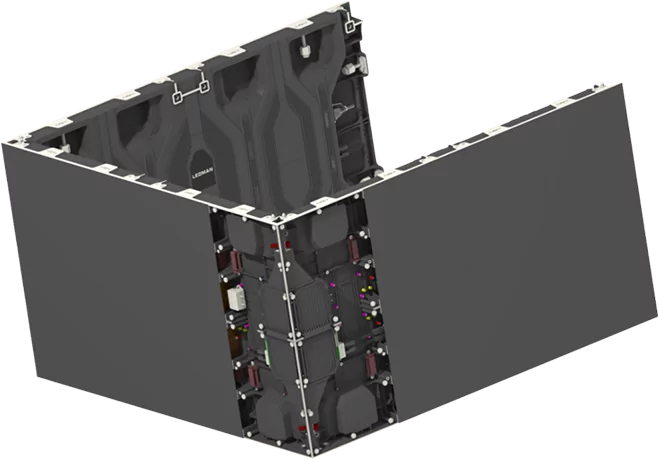
Corner layouts create additional design possibilities. An LED SMD right angle configuration can help screens follow architectural edges or create two-sided visual fields without leaving a large visual gap at the corner. Such arrangements require accurate cabinet measurements and careful consideration of viewing angles.
Temporary applications also benefit from predictable content management. Event organizers commonly switch between schedules, sponsor graphics, live feeds, and presentation material. Compatibility with media servers, processors, cameras, and other AV equipment should therefore be checked before the display is selected.
Corporate Displays And Presentation Environments
Corporate spaces usually prioritize image clarity, professional appearance, and integration with existing meeting-room equipment. Boardrooms may require detailed charts, spreadsheets, video conferencing feeds, and presentation slides to remain legible from multiple seating positions.
Pixel pitch should be matched to the room rather than selected solely according to the highest available specification. Smaller conference rooms typically place viewers closer to the screen, making finer pitches more valuable. Larger auditoriums can often accommodate greater pixel spacing without noticeably reducing viewing quality.
Physical installation also affects long-term usability. Cable routing, ventilation, processor placement, and access for service should be considered during the architectural planning stage. Such details can have more practical influence on daily operation than headline resolution figures.
Choosing Between Indoor And Outdoor Deployment
Indoor and outdoor applications should not be treated as interchangeable simply because both rely on LED technology. Indoor projects generally focus more heavily on viewing comfort, fine detail, cabinet integration, and acoustic or architectural considerations. Outdoor projects place greater emphasis on brightness, environmental protection, structural mounting, and long-distance visibility.
Screen dimensions should follow the communication objective. A narrow retail display may prioritize portrait-oriented content, whereas an outdoor advertising installation could require a much wider canvas. Corporate environments, meanwhile, often benefit from proportions that align naturally with presentation formats.
Service planning deserves equal attention. Front access can simplify maintenance where rear space is restricted, while rear access may be practical inside dedicated equipment areas. Choosing the appropriate access method during design can reduce disruption later.
Practical Selection And Installation Factors
Before purchasing, project teams should document viewing distance, screen dimensions, brightness conditions, content sources, operating hours, and installation location. Those inputs provide a more useful basis for comparing specifications than price or resolution alone.
Panel geometry becomes especially important for unusual architectural layouts. With an LED SMD right angle design, measurements around columns or 90-degree corners need to account for cabinet depth, connection points, structural tolerances, and the desired visual continuity across surfaces.
Ledman’s K Series illustrates how product specifications can support practical deployment. Its fully die-cast aluminum cabinet weighs approximately 15kg per panel and is designed to provide high precision and flatness while remaining relatively thin for transport. Pixel-pitch choices of 1.5mm, 1.6mm, 1.8mm, 2.0mm, 2.6mm, and 3.2mm allow configuration according to viewing conditions rather than forcing every project into one specification.
Conclusion
Different display environments call for different priorities. Retail projects tend to reward close-viewing clarity, outdoor advertising depends heavily on brightness and environmental considerations, event installations benefit from transport and setup flexibility, while corporate spaces require strong AV integration and comfortable viewing.
Understanding the application before selecting equipment makes specification decisions more rational. Whether the project calls for an SMD LED screen across a large advertising surface or a finely detailed indoor installation, viewing distance, physical constraints, maintenance access, and content requirements should remain central to the evaluation. Ledman provides multiple display configurations that can be considered alongside those project-specific factors rather than treated as a universal solution.