
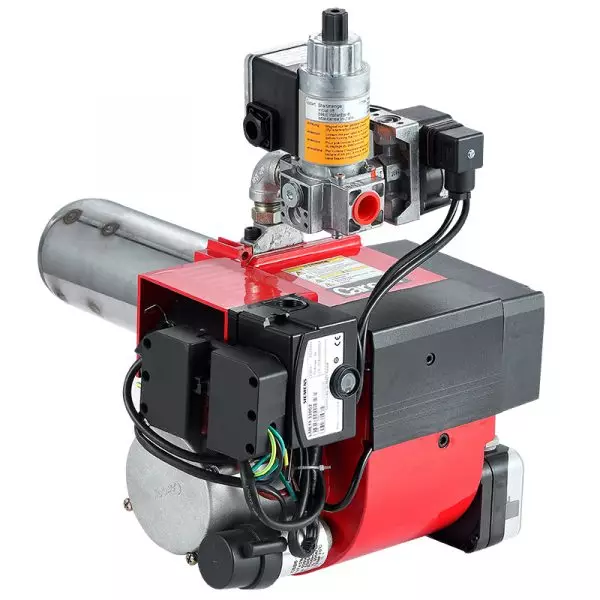
High-efficiency gas burners can help industrial plants obtain required process heat while using fuel more effectively. Their value is not limited to a combustion-efficiency figure. Fuel demand, heat output, control response, emissions, and burner configuration all influence the overall result.
For facilities operating boilers, furnaces, ovens, dryers, or other thermal equipment, the main question is therefore how efficiently the burner converts supplied gas into useful heat under actual operating conditions.
Lower Fuel Demand Starts With Better Combustion
A high efficiency gas burner is designed to convert fuel into usable thermal energy with limited combustion losses. Career Burner states that its gas-fired burner range combines high efficiency with reliability and precision control, supporting industrial heating requirements across different operating conditions.
A gas burner mixes fuel with combustion air and ignites the mixture to create a controlled flame. The resulting heat is transferred into the process equipment. Better control of that combustion process can help reduce energy that would otherwise leave the system without contributing sufficiently to useful heating.
Career Burner lists gas-fired burners from 50 kW to 7000 kW, giving plants the opportunity to select equipment according to their required thermal output rather than treating one burner size as suitable for every installation.
Capacity and Control Matter as Much as Rated Efficiency
Industrial heat demand rarely remains perfectly constant. Production rates, process stages, startup conditions, and temperature requirements can change the amount of heat required from the burner.
A gas fired burner with appropriate control capability can respond to those changing requirements instead of operating continuously at a level that does not correspond to the actual process load. Career Burner’s product range includes modulating and automatic configurations, providing different approaches to controlling burner output.
Correct capacity selection is equally important. An oversized burner may provide more output than the process normally requires, while an undersized unit may struggle to meet peak thermal demand. The practical benefit of high efficiency therefore depends on matching burner capacity and control characteristics to the equipment’s operating profile.
Cleaner Combustion Can Support Industrial Operating Goals
Fuel efficiency and emissions are different performance criteria, but combustion quality affects both. Poorly controlled combustion can create undesirable operating conditions, while a well-engineered system can balance heat release with emissions objectives.
Career Burner’s gas-fired burner range is described as combining high efficiency, low emissions, and precision control. The company also states that its gas burners are designed to minimize carbon emissions.
That combination can be relevant to plants seeking to improve thermal performance without treating emissions management as a completely separate engineering problem. Burner selection should still reflect the specific combustion chamber, fuel, process temperature, and applicable emissions requirements.
One Burner Range Can Serve Different Heat Loads
A major industrial advantage of efficient gas combustion equipment is scalability. Different processes require very different quantities of heat, so burner capacity must correspond to the equipment rather than simply the size of the facility.
The referenced product category covers a 50–7000 kW range and includes multiple burner configurations. Career Burner describes options ranging from compact units to heavy-duty systems and from lower-power equipment to high-output, multi-stage systems.
Fuel flexibility can also affect plant planning. The listed burners are compatible with natural gas, LPG, and various process gases, depending on application requirements. Such flexibility can be useful where fuel availability or the process itself varies between installations.
Why Burner Configuration Affects the Result
Efficiency cannot be separated from the surrounding thermal equipment. The same burner can behave differently depending on furnace geometry, combustion-air conditions, required flame characteristics, control strategy, and heat-transfer requirements.
For that reason, choosing a high efficiency gas burner should begin with the required heat output and fuel type. Engineers should then examine combustion efficiency, flame stability, emission requirements, and available control features. Career Burner’s own selection guidance identifies these factors when determining the appropriate gas-fired burner for a heating application.
Control architecture also influences how effectively the burner follows process demand. Automatic or modulating operation can be particularly relevant where the heat requirement changes rather than remaining fixed throughout production.
What High Efficiency Means for an Industrial Plant
The practical benefit of a high-efficiency burner is better use of the energy contained in the supplied fuel. Career Burner’s product information states that gas burners typically achieve thermal efficiency ratings between 92% and 98%, although actual suitability depends on the specific heating application.
For plant operators, that efficiency should be considered alongside controllability, capacity, fuel compatibility, emissions, and reliability. A burner with strong efficiency characteristics still needs to be correctly sized and integrated with the thermal equipment to deliver its intended value.
Ultimately, high-efficiency gas burners can offer industrial plants lower fuel demand, better matching of heat input to process requirements, controllable operation, and lower-emission combustion. The greatest benefit comes when burner capacity, fuel, combustion characteristics, and control method are selected as one integrated system.