
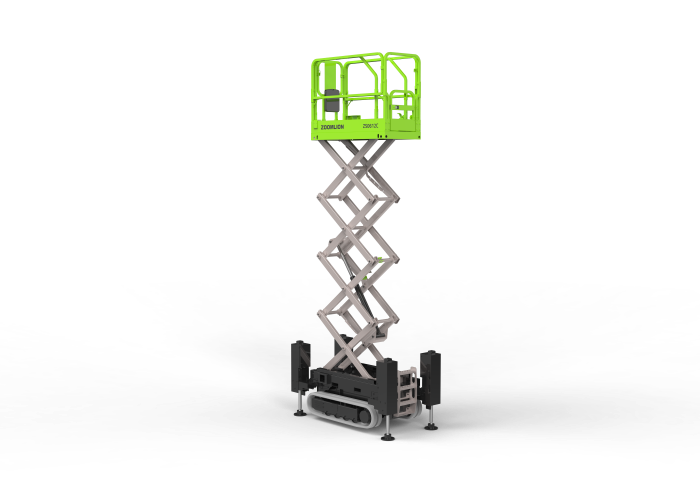
A crawler scissor lift can expand a contractor’s access fleet when projects involve uneven surfaces, restricted routes, or changing ground conditions. However, adding another MEWP category does not have to make fleet planning complicated. The key is to define the jobs that justify tracked access, understand the operating limits, and position the machine as a complement to existing wheeled equipment rather than a replacement for everything else.
Start With the Jobs the Fleet Already Handles
Fleet decisions are easier when based on recurring work instead of isolated projects. Review where current scissor lifts struggle with soft ground, uneven terrain, narrow routes, or access between finished and unfinished areas. A scissor lift with tracks can then be considered for tasks where its travel system addresses a specific site requirement.
This approach also prevents contractors from overbuying. Not every elevated task needs a tracked machine, and not every tracked machine suits every surface. IPAF advises users to consider ground type, slope, hazards, machine weight, and whether the selected MEWP has suitable tyres or tracks for the terrain.
Understand Where Tracked Access Adds Value
Ground conditions can change significantly during construction. Excavation, backfilling, weather, temporary routes, landscaping, and unfinished surfaces may create areas where standard wheeled access equipment becomes less suitable. A tracked configuration can give contractors another option when route conditions are part of the access problem.
The objective is not to treat tracks as permission to ignore ground assessment. IPAF stresses that the machine must still be suitable for the ground and that operators should assess the full route before travelling. Soft spots, slopes, excavations, underground services, and changing site conditions can affect MEWP stability and mobility.
Keep Fleet Planning Based on Measurable Requirements
A simple fleet matrix can cover working height, platform capacity, machine width, machine length, ground clearance, gradeability, turning capability, and transport weight. These figures help planners distinguish between machines that appear similar but serve different site conditions.
For example, a contractor could define one group for paved indoor work, another for general outdoor surfaces, and another for terrain where a scissor lift with tracks is appropriate. This functional approach keeps purchasing decisions connected to application requirements rather than creating unnecessary overlap among fleet categories.
Consider Transport and Site Logistics
Adding a new machine also means considering how it reaches projects. Overall dimensions and gross weight affect loading, hauling, unloading, and site access. Contractors should check whether existing transport arrangements can handle the equipment and whether loading areas provide sufficient space for safe movement.
HSE guidance recommends assessing the route a MEWP must travel, including hard or soft ground, slopes, uneven areas, kerbs, underground hazards, and potential interaction with pedestrians or vehicles. These factors should be reviewed before the machine reaches its final work position.
Build Training Around the Actual Equipment
Fleet simplification does not mean assuming all scissor lifts operate identically. Controls, dimensions, drive characteristics, allowable slope, platform capacity, and operating restrictions can vary between models. Operators therefore need equipment-specific familiarity alongside general MEWP training.
Pre-use inspection should also remain part of the routine. OSHA guidance calls for checks before each work shift, covering items such as controls, brakes, tires, batteries, guardrails, wiring, and other components identified by the manufacturer. Defective equipment should be removed from service until properly repaired.
How Zoomlion Access Positions the ZS0612C
For contractors evaluating a crawler scissor lift, the ZS0612C from Zoomlion Access provides a clearly defined specification set. Its maximum working height is 7.8 m, with a 5.8 m elevated platform height and a rated platform capacity of 230 kg. The machine weighs 1,900 kg and has a 0.9 m platform extension.
The ZS0612C has an overall width of 1.15 m and overall length of 2.19 m, with 0.08 m ground clearance. Its listed gradeability is 30% or 17°, while the maximum working slope is 12° laterally and 7° vertically. These specifications give procurement teams measurable boundaries for deciding which projects should use the machine.
Where the ZS0612C Fits in a Contractor Fleet
The ZS0612C uses a 24V/2×2 kW drive motor arrangement and a 4×12V/240Ah battery system. Its listed travel speed when stowed is 2 km/h, while the platform cannot be driven when raised. The machine has a 0 m turning radius and rear-wheel drive and braking, providing a compact set of parameters for maneuvering and fleet planning.
For a scissor lift with tracks strategy, the model can therefore be assigned to jobs where its crawler configuration and specified operating envelope provide a practical alternative to standard wheeled access equipment. That approach allows contractors to add capability without expecting one machine to cover every access requirement.
Why Zoomlion Access Can Support Fleet Expansion
Zoomlion Access offers a broader MEWP portfolio covering scissor lifts, articulating boom lifts, telescopic boom lifts, telehandlers, spider lifts, vertical mast lifts, and vehicle-mounted boom lifts. Its company information states that its range covers working heights from 6 m to 82 m and includes more than 100 MEWPs across five major product categories.
For contractors, that broader range makes equipment selection easier to structure around application rather than brand duplication. A crawler scissor lift such as the ZS0612C can fill a defined terrain-access role, while other fleet machines continue handling tasks better suited to different heights, surfaces, outreach requirements, or access configurations.
A practical fleet strategy is to identify recurring site conditions first, establish the required specifications second, and then assign each machine a clear role. With those boundaries in place, adding a scissor lift with tracks becomes a targeted fleet expansion rather than another layer of complexity, while Zoomlion Access provides multiple MEWP categories for contractors building a more structured access equipment fleet.