
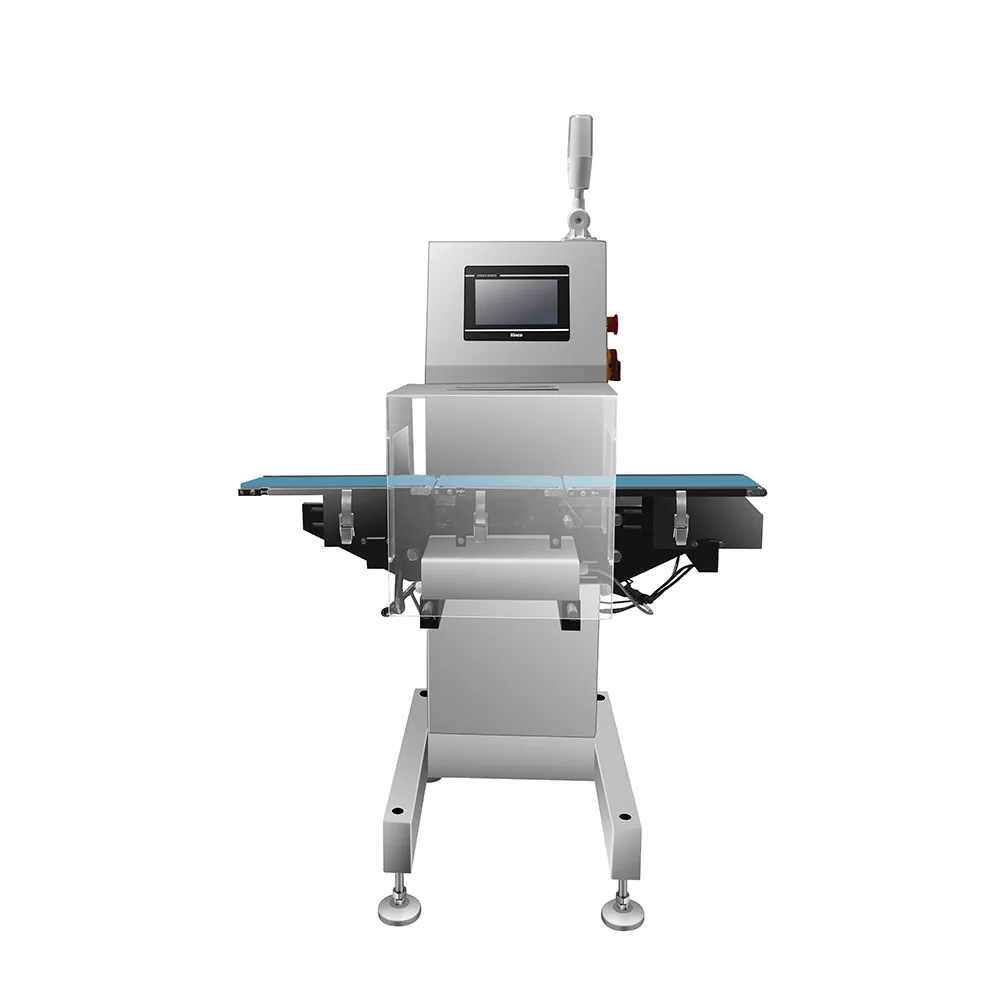
Catching underweight retail packages before they exit the factory floor prevents costly regulatory fines and severe consumer complaints. Modern packaging lines rely on automated inline verification to monitor net weight compliance continuously during active production shifts.
Quality audits become real-time fault interception operations across plant floors with an accurate checkweigher. Meeting high international requirements while maintaining precise weight accuracy secures company profit margins. Production supervisors rely on these automated tools to reduce human mistakes and boost productivity.
The Infeed Transition and Dynamic Weight Capture
During the inspection station, the items are transferred from the filling equipment located farther upstream to the specialised infeed belt. Prior to moving onto the active weighing platform, precisely synchronised speed ensures that individual packages keep the appropriate distance between them.
Erroneous sensor readings and mechanical interference can cause dynamic weight capture to fail when packages are stacked on top of one another or overlap. For each and every item that is processed, precise timing parameters are determined using high-speed optical sensors that monitor the intervals at which products are entered.
Maintaining consistent belt velocity is essential to prevent momentum distortion during active transit across the scale. Roller alignment and low-friction bearings guarantee smooth transfer without introducing mechanical shocks that skew analytical data during high-speed runs.
Once an item occupies the active weighing deck, the system measures downward gravitational force instantly. Specialized strain gauge load cells or electromagnetic force restoration sensors capture gross mass precisely under heavy industrial workloads.
Gravitational Force Conversion and Load Cell Mechanics
These precision components convert physical downward pressure into proportional electrical voltage signals within fractions of a second. The physical structure of the platform must remain completely rigid to resist ambient factory vibrations effectively.
It is possible to avoid transitory industrial shocks from accessing sensitive electronic circuits by isolating the load cell from the conveyor machinery that is around it. Engineers design robust platforms to maintain mechanical stability. These units can sustain millions of operation cycles under harsh manufacturing‑plant conditions.
For the purpose of maintaining accuracy, it is necessary for internal compensation circuits to take into account environmental parameters such as fluctuations in the ambient temperature and humidity levels. In order to guarantee consistent measurement findings over a wide range of product lines and temperatures on the factory floor, structural stiffness continues to be a crucial component.
In order to establish the underlying physical structure that is required for high-precision dynamic weighing systems, certain mechanical safeties are essential.
Digital Filtering and Tare Subtraction Algorithms
Once the electrical signal is generated, it is passed directly to the high-speed digital signal processor for comprehensive data cleaning. Raw electrical voltages generated during movement always contain background noise from motor friction and conveyor belts.
High-speed digital signal filters eliminate these mechanical disturbances to isolate true net mass values accurately. Microprocessors subtract pre-programmed tare weights instantly from gross measurements to determine exact product contents.
Sophisticated algorithms ensure that minor product shifting inside flexible pouches never disrupts calculation accuracy during runtime. Advanced systems engineered by Easyweigh utilize specialized digital filters to stabilize data sets under heavy workloads. This rigorous mathematical processing guarantees absolute measurement fidelity before weight comparison logic activates across the terminal.
Tolerance Comparison and Underweight Classification
Calculated net weight data passes instantly into the central control processor for immediate tolerance evaluation. The software compares final values against strict lower target weight boundaries established by facility quality standards.
When a package falls below the pre-set minimum limit, the processor classifies it instantly as an underweight defect. Industrial units developed by this brand execute this comparison logic within milliseconds of data capture.
This rapid evaluation prevents non-compliant items from mingling with acceptable goods on the primary conveyor line. Strict lower-limit enforcement protects manufacturers against statutory penalties imposed by Weights and Measures authorities. Automated software checks ensure that classification thresholds remain completely stable throughout extended multi-shift production runs.
High-Speed Rejection and Upstream Feedback Mitigation
If the system physically removes the item from the queue soon after it has been identified as being underweight, then the identification will be successful. After the anomaly confirmation has taken place, milliseconds later, precision high-speed pneumatic pushers or air-blast nozzles start their operation.
The selection of a dependable checkweigher guarantees that rejected items will be placed safely into lockable collection bins without causing any disruption to the products that are close to them.
It is important to ensure that detection data is sent immediately into bidirectional communication channels that are connected to upstream fillers in order to prevent repeated problems. Taking preventative measures to correct dose quantities can reduce the number of systemic underfilling problems that occur before whole batches fail compliance inspections.
With the help of Easyweigh’s innovative monitoring systems, chronic underweight production runs may be eliminated. This is accomplished by changing passive inspection gear into active process optimisation centers.