
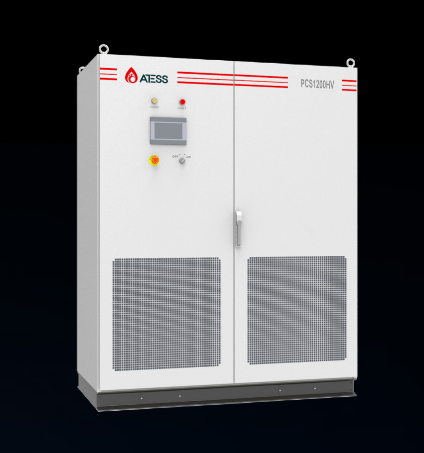
Many industrial energy professionals face a common question when planning a storage project—whether to deploy a bidirectional Power Conversion System or stick with a conventional grid-tied inverter. The decision largely depends on whether the application requires battery storage management. For projects needing both charging and discharging control, a bidirectional battery inverter is the preferred choice. Atess designs its PCS lineup precisely for these scenarios, offering industrial users a clear path forward.
How a Bidirectional PCS Differs from Standard Grid-Tied Inverters
A Power Conversion System (PCS) functions as the core energy management and conversion unit for larger-scale storage systems. Unlike standard grid-tied inverters that only convert DC from solar panels to AC, a bidirectional battery inverter manages two-way power flow—converting AC from the grid into DC to charge batteries and DC from batteries back into AC to power loads or feed into the grid. This bidirectional capability is what sets a true Power Conversion System apart from simpler inverter types.
Standard grid-tied inverters cannot operate during a utility failure; they shut down for safety reasons. A bidirectional battery inverter, however, continues working in off-grid mode, providing backup power when the grid goes down. Atess offers bidirectional battery inverters ranging from 100kW to 1500kW, specifically engineered for industrial, commercial, and grid-level applications.
Matching the Right Technology to the Application
For facilities that simply need to convert solar DC to AC and feed into the grid, a conventional grid-tied inverter may be sufficient. But for operations requiring energy storage—load shifting, peak shaving, or backup power—a bidirectional Power Conversion System is necessary. The battery inverter enables stored energy to be discharged when rates are higher or during outages, whereas a grid-tied inverter provides no such flexibility.
Atess also supports parallel operation of its battery inverters, with up to eight units working together to reach 12MW capacity for larger energy demands.
In summary, any project that involves battery storage needs a bidirectional battery inverter. Facilities requiring only solar-to-grid conversion can use a standard grid-tied inverter, but those seeking energy independence, backup power, or load management should choose a bidirectional Power Conversion System. The technical distinction directly determines what the system can and cannot do. Atess provides industrial-grade bidirectional battery inverters that handle both grid-tied and off-grid operation, giving users flexibility across various application scenarios.