
Professional 3D printing operations need more than a resin that produces attractive parts. Material consistency, printer compatibility, mechanical performance, post-processing requirements, and supply continuity can all affect production efficiency. For businesses using resin 3D printing for prototypes, models, functional parts, or presentation pieces, evaluating a resin supply requires a broader view than comparing price per bottle.
Material Performance Should Match the Application
The first consideration is whether a resin’s properties fit the intended application. Different professional projects may prioritize dimensional stability, impact resistance, flexibility, heat resistance, surface appearance, or transparency. A material selected primarily for appearance may not be appropriate for a component exposed to repeated mechanical loads.
Professional buyers should therefore review measurable properties instead of relying only on general descriptions. Tensile strength, flexural strength, elongation, hardness, viscosity, and shrinkage can help purchasing teams compare materials more objectively. SUNLU’s resin range includes standard, tough, flexible, ABS-like, high-temperature, dental, and other specialized formulations, reflecting the different requirements found across professional workflows.
Printer Compatibility and Process Stability Matter
A suitable resin supply must also work reliably with the printing equipment used in production. LCD-based resin printers can require specific exposure settings depending on the material, layer thickness, printer screen, and other process conditions. Consistent results depend on establishing suitable parameters rather than assuming one setting works for every formulation.
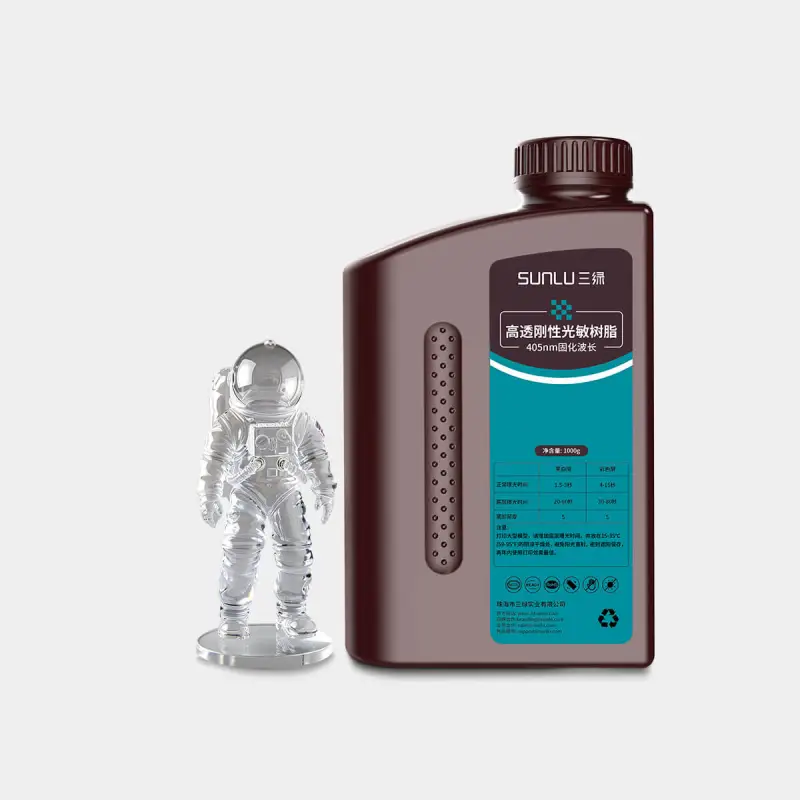
SUNLU High Clear Resin, for example, lists a viscosity of 300–600 mPa·s/℃ and provides recommended monochrome LCD exposure ranges of 10–50 seconds for bottom layers and 4–7 seconds for regular layers. Its recommended lifting speed is 60–90 mm/min. These published parameters give professional users a practical starting point for process setup.
Consistency Is Central to Professional Resin Supply
For businesses producing repeated batches, material consistency can be as important as the headline performance of a resin. Variations in curing behavior, flow, color, or finished-part characteristics may create additional calibration work and increase the risk of inconsistent output.
A professional supplier should therefore provide clear technical documentation and material information. It is also useful to evaluate whether the supplier has manufacturing capabilities that can support continuing demand. SUNLU describes itself as an integrated enterprise covering the research, development, manufacturing, and sales of 3D printing materials and related electronic products. Its current operations include production bases in China and Vietnam.
Appearance Can Be a Production Requirement
For design studios, product-development teams, model manufacturers, and other businesses where visual presentation matters, optical characteristics can become an important material-selection criterion. Transparent parts, display models, lenses, and fluid-channel prototypes may require a different approach from ordinary opaque components.
SUNLU High Clear Resin is designed around this requirement. The manufacturer states that it offers resistance to yellowing and blue edge effects, while a gloss varnish can help achieve a glass-like transparent finish. The product is supplied in a 1000 g clear format and lists 28 MPa tensile strength, 30 MPa flexural strength, 76 J/m notched Izod impact strength, and 80 Shore hardness.
Post-Processing Should Be Part of the Evaluation
Material selection does not end when a part leaves the printer. Washing, curing, sanding, coating, and other finishing steps can influence labor requirements and production time. Professional purchasers should consider the complete workflow when comparing materials rather than evaluating only printing performance.
For High Clear Resin, SUNLU recommends ultrasonic cleaning with 95% ethanol or IPA for 2–5 minutes and a curing time of 5–10 minutes. The manufacturer also recommends a project temperature of 25–30°C and a 0.05 mm print layer thickness. Such guidance can help production teams establish a repeatable workflow during material testing.
Supply Capacity and Supplier Support
A dependable resin supply also involves availability, technical assistance, and communication. Businesses purchasing materials repeatedly may need more than standard retail ordering. They may require bulk quantities, material-selection assistance, after-sales support, or documentation for internal qualification procedures.
SUNLU’s official contact information specifically provides business cooperation, order inquiry, and after-sales channels, and the company states that its team can assist with material selection and bulk-order inquiries. Its product portfolio currently covers multiple resin categories, allowing professional users to evaluate different formulations within one supplier ecosystem.
Building a Practical Resin Sourcing Strategy
The most effective approach to resin 3D printing material sourcing is to define requirements before comparing suppliers. A purchasing team can begin with the application, required properties, printer compatibility, expected production volume, finishing process, and acceptable unit cost. Sample testing can then verify whether the material performs consistently under the company’s actual production conditions.
For businesses considering a long-term resin supply, supplier capability should be evaluated alongside individual product performance. SUNLU combines a broad resin portfolio with dedicated material-development resources and manufacturing operations. Its current range includes functional, high-precision, engineering, washable, and esthetic resin categories, providing options for different professional applications.
Making Material Selection a Long-Term Decision
A professional resin purchasing decision ultimately involves balancing technical performance, workflow efficiency, supply reliability, and application requirements. Rather than choosing solely by price or marketing claims, businesses can compare documented specifications and validate materials through controlled printing tests.
SUNLU provides a broad resin supply portfolio for professional users, while its High Clear Resin addresses applications where transparency and long-term visual appearance are important. For companies developing a repeatable resin 3D printing workflow, evaluating material specifications, processing requirements, and supplier support together can create a more reliable foundation for ongoing production.